Most training is built for the middle of the room. Then it is measured on who finished. I have spent twenty years asking whether anyone learned anything. This is what came out of that question. For each piece, here is what was going wrong, what it does about it, and how big it is.
Zavmo is the work itself. It teaches one person at a time, by asking them to do things. Then it keeps the proof. It is the platform I needed at school and did not have.
Ask somebody where their job is going and they cannot tell you. Neither can their employer.
Job adverts say one thing. Qualifications say another. Nothing joins them up. So people buy a course and hope.
What it does
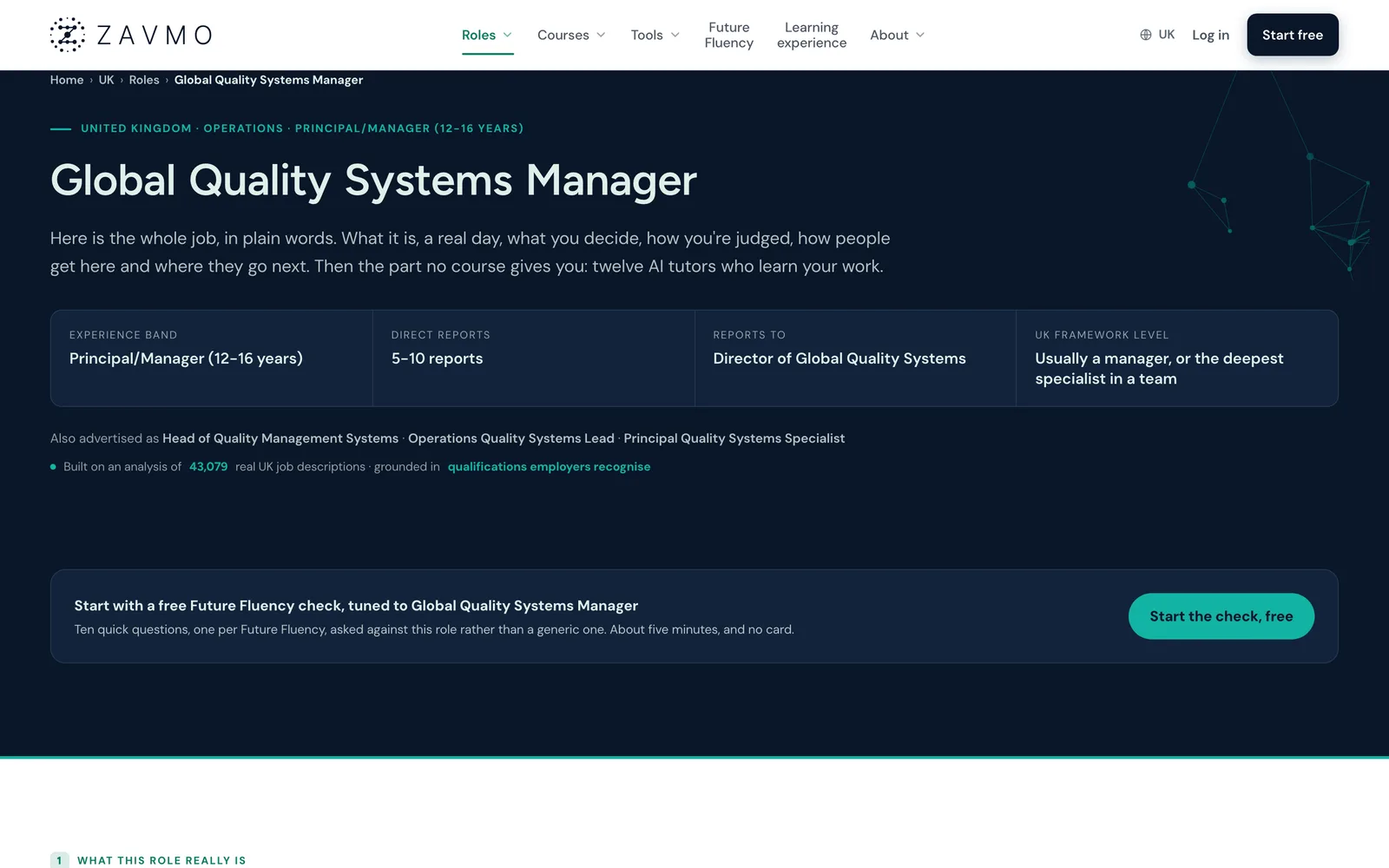
We read the UK job market and joined it up. Type the job you do. You get the whole role in plain words. The level it sits at. Where people go next.
Then you get the skills it is moving towards, and the qualification that fits. Nobody wrote these pages by hand. Each one is built from the catalogue when you open it.
The size of it
Over 43,000 UK job descriptions read.
Over 33,000 roles you can search.
2,825 qualifications, from 130 awarding bodies.
Counted in August and September 2026.
One role out of more than 33,000. The whole job, in plain words.
Most online learning is a video and a quiz. Everyone gets the same one, in the same order. Finishing it gets called learning.
I have watched that fail for twenty years.
What it does
This one adapts to the person, all the way through. You pick the job you do, the job you want, or a qualification. It checks what you already know. Then it builds the course from the gaps, and only the gaps.
A lesson is a conversation, not a video. Twelve teaching characters each explain in a different way. A thirteenth agent that nobody sees watches pace, engagement and how loaded you are. It suggests who should step in. Back to basics, a case study, a coach.
Get something wrong and it teaches it again, another way. Nobody is handed a tutor because of a label. The switching is the adjustment. The rules that protect neurodivergent learners always win.
It remembers what you have learned, and it shows you what it remembers. It can teach you in your own language.
Every answer is kept against the exact criterion it proves. So the end is a record of what you can do, not a tick.
The size of it
Twelve teaching characters and one orchestrator.
More than 2,100 commits since February 2026.
213 kinds of learning event defined. 190 of them were wired up when we counted in July.
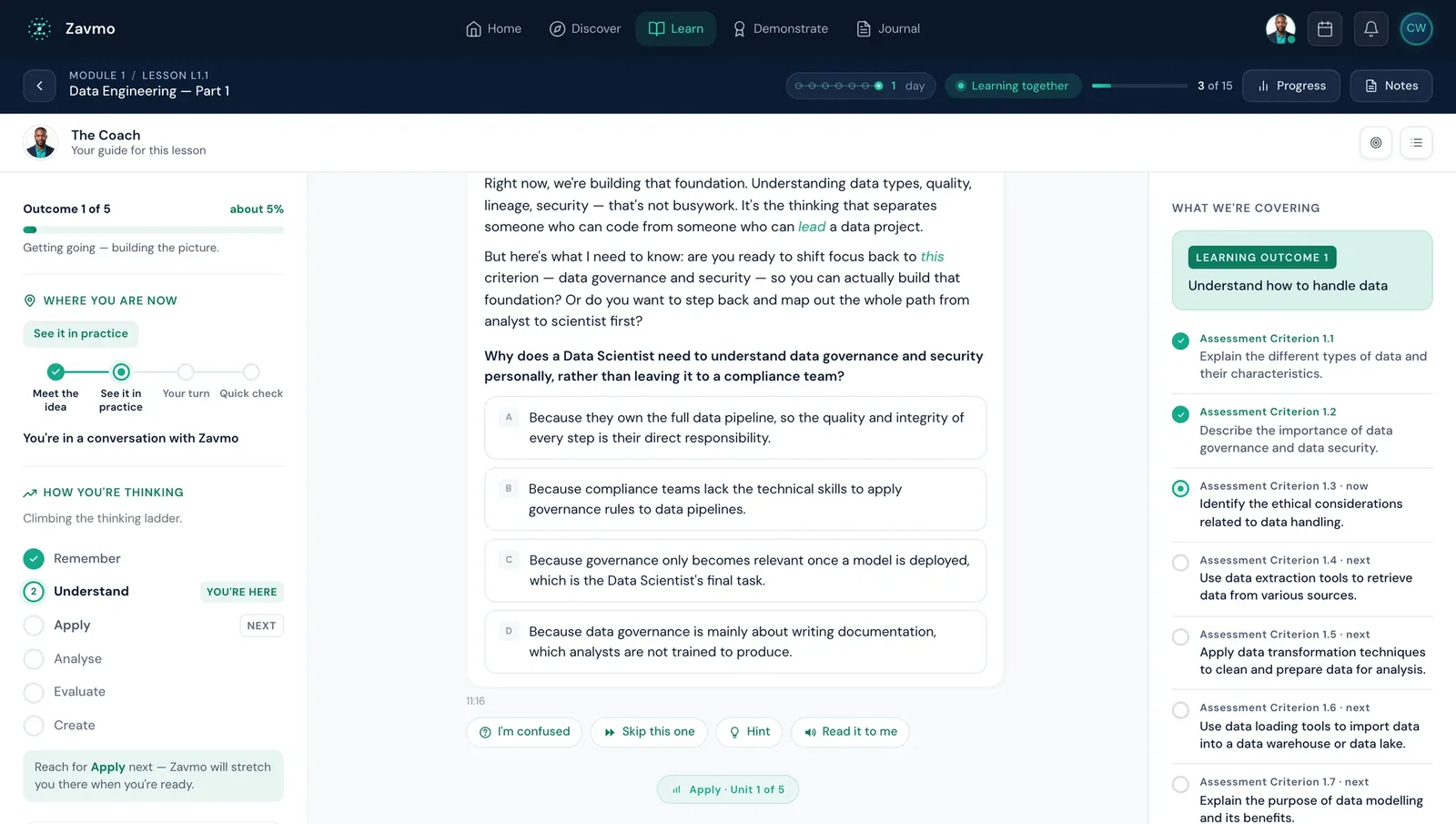
A lesson in progress. The thinking ladder is on the left. The conversation is in the middle. The criteria it is proving are on the right.The twelve tutors. None of them is a real person.
People who run training spend their week inside dashboards. They click through reports to find the three people who need them. The system already knows who those three are. It just never says.
Building a learning pathway is slow. Getting a report out usually means asking somebody technical.
What it does
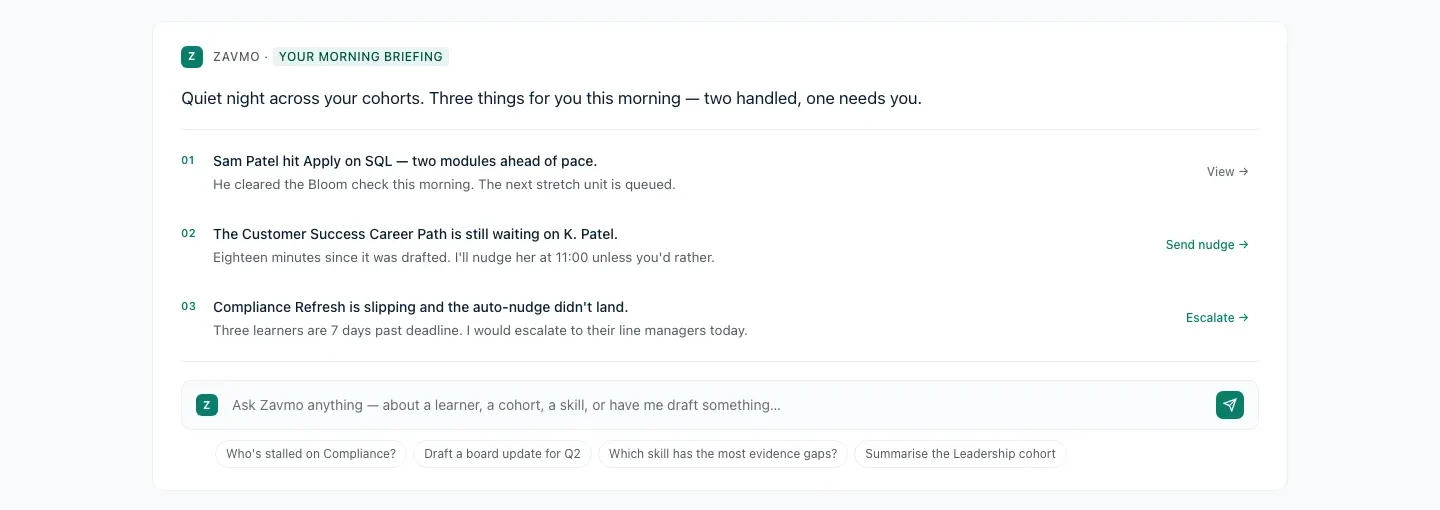
This is a full admin dashboard, and you run it by talking to it. It opens with a morning briefing. What happened overnight, what it handled, what needs you.
Pathways are built by conversation. Start from a job description, a set of skills, a subject or a blank page. Say what you want and it drafts all four stages. Then you shape it. Change one stage and it redrafts only that one.
Reports work the same way. Ask what you want to know. You get a summary, and the full table behind it, ready to export.
Around that sits everything an organisation needs. People and cohorts. Its own branding. A log of every prompt the AI ran, because somebody has to be able to check.
Most AI learning products borrow their teaching from a giant general model. That model was trained on the internet. Nobody trained it to teach. It never finds out whether the lesson worked.
So the teaching never gets better. The thousandth learner gets the same lesson as the first.
What it does
Saraswati is our own small language model, named for the goddess of knowledge. It has one job. Make the instruction better over time. On every platform it sits behind, for every organisation running it.
It learns from what worked. Did the learner make progress? Were they stretched without being lost? Did they come back? Did they get curious and go further than they were asked?
Teaching that led there is kept. Teaching that led to a closed tab is kept too. It is the example of what not to do.
It never trains on what a learner typed. It sees the shape of what happened, never the words. It is tuned for each country. A UK qualification and a Singapore one are not the same thing.
A new version has to pass a test before it teaches anybody. If the teaching gets worse, it rolls back. The human is served first. That is the rule it is built around.
It is built, and it is not switched on yet. It goes live when it beats the big models we use today, and not before.
The hardest problem in learning is not content. It is getting people to come back.
A normal chatbot is a search box that waits to be asked. Most people never ask. They open their learning platform a few times a year, usually because somebody made them.
What it does
Little Zav is a proactive chatbot. It speaks first. It greets you by name when you log in, and it already knows what you learned last. Nobody faces a blank box.
Every visit it has one small new thing for you, about twenty seconds long. A mini quiz on last week’s lesson. A myth or a fact. Something interesting you did not know. Win and you earn a spark. Get it wrong and it wobbles and lets you try again. It never punishes.
It answers questions too. It answers only from the content an organisation connects to it, and it names the source. If it does not know, it says so. It never guesses.
And it asks for feedback while the learning is fresh. How confident do you feel? What mood are you in? Is this landing? To the learner that is a ten second question.
To the organisation it is a live read on whether the learning worked. We track it on the Kirkpatrick model, which is how the training world measures that. Nobody is ever shown by name.
It is its own product. It drops into any learning platform, not only mine. Zavmo is its first customer, and it is the voice in the corner of zavmo.ai.
The size of it
Fifteen ways to play.
Twelve sparks complete the Zavmo mark.
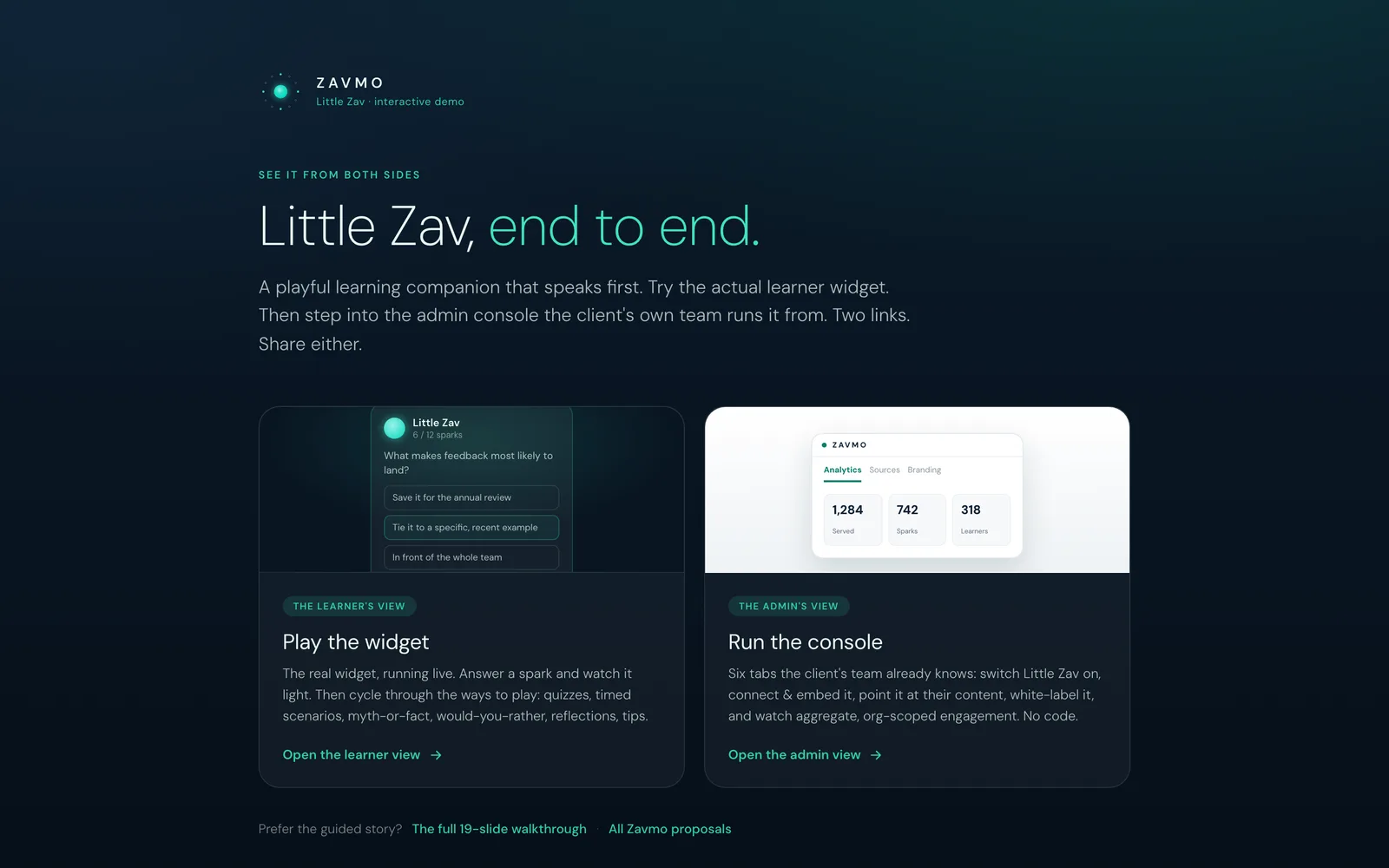
Both sides of it. The learner widget, and the console a client runs it from. Demo data.
The reason these exist separately is that a learner, an administrator and a tutor want different things from the same data. One screen trying to serve all three serves none of them. How Zavmo is built.
What it teaches
A platform is only as good as the curriculum on it. This is the part I write rather than build.
A qualification describes the job as it was when somebody wrote it. AI is changing the job faster than that.
When we read the job market, the same ten things kept coming up. No qualification covered them.
What it does
So I wrote them down. AI, data, AI governance, automation, sustainability, frontier, foresight, change, trust and systems.
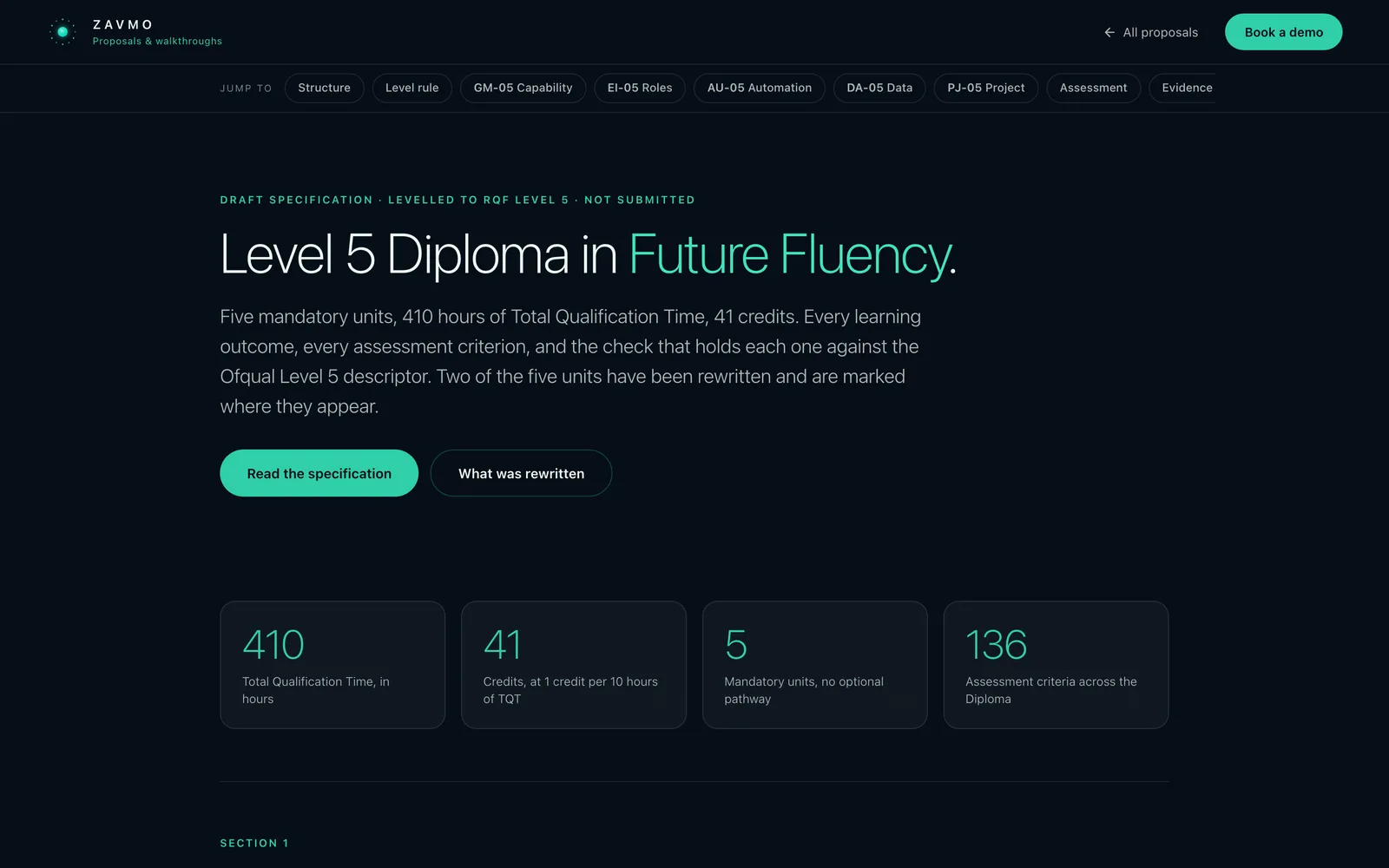
Then I wrote two qualifications the long way. Every unit, every learning outcome, every assessment criterion.
They are applied to your own job, and that is the whole point. At Level 3 you change your own daily work. At Level 5 you lead a department through the same shift. Your job is the evidence, not a case study about somebody else.
Both are drafts for review. Neither has been submitted.
The Level 5 specification. Published in full, as a draft, so anybody can pick holes in it.
Zavmo is not an awarding body and I will not say it is. Recognition is a regulated process that takes years, and we are at the start of it. Writing the curriculum is one input to that, not the whole application.
How I run the business
These are mine rather than the product’s. I built them for the same reason I built Zavmo. I wanted to see whether the idea holds when it is turned on me. All three sit behind a sign-in.
Mini Me
Decision memory
The problem
On 22 August I had seventeen things waiting on me. Four of them I had already decided. One asked whether to keep a piece of work I had closed three days before.
A decision was only ever a sentence inside a task. Tasks get finished and filed away, and the decision goes with them.
What it does
Mini Me keeps the decision as its own thing. What I chose, what I turned down, why, when, and what would change my mind.
I work with a coordinator and eleven specialist agents. Design, security, privacy, data, curriculum and the rest. Before any of them starts, it asks the record whether I have already answered.
The refusals are the part that matters. Two of my rules cost money on purpose. Anything built to chase revenue would quietly undo them.
The size of it
One coordinator and eleven specialists.
252 commits since July 2026.
Flywheel
Business to business lead generation
The problem
Most business outreach is boilerplate. The same email goes to a thousand people with the name changed. Everybody can tell, and everybody deletes it.
Doing it properly means researching every organisation first. That takes time nobody has, so it does not get done.
What it does
Flywheel is a lead generation tool built on research. It studies an organisation before anybody contacts it. What they are trying to do. What is getting in their way.
Then it maps that research onto what we do best. Which of our strengths answers a problem they already have? That match is the message. So the outreach is targeted and personal, never boilerplate.
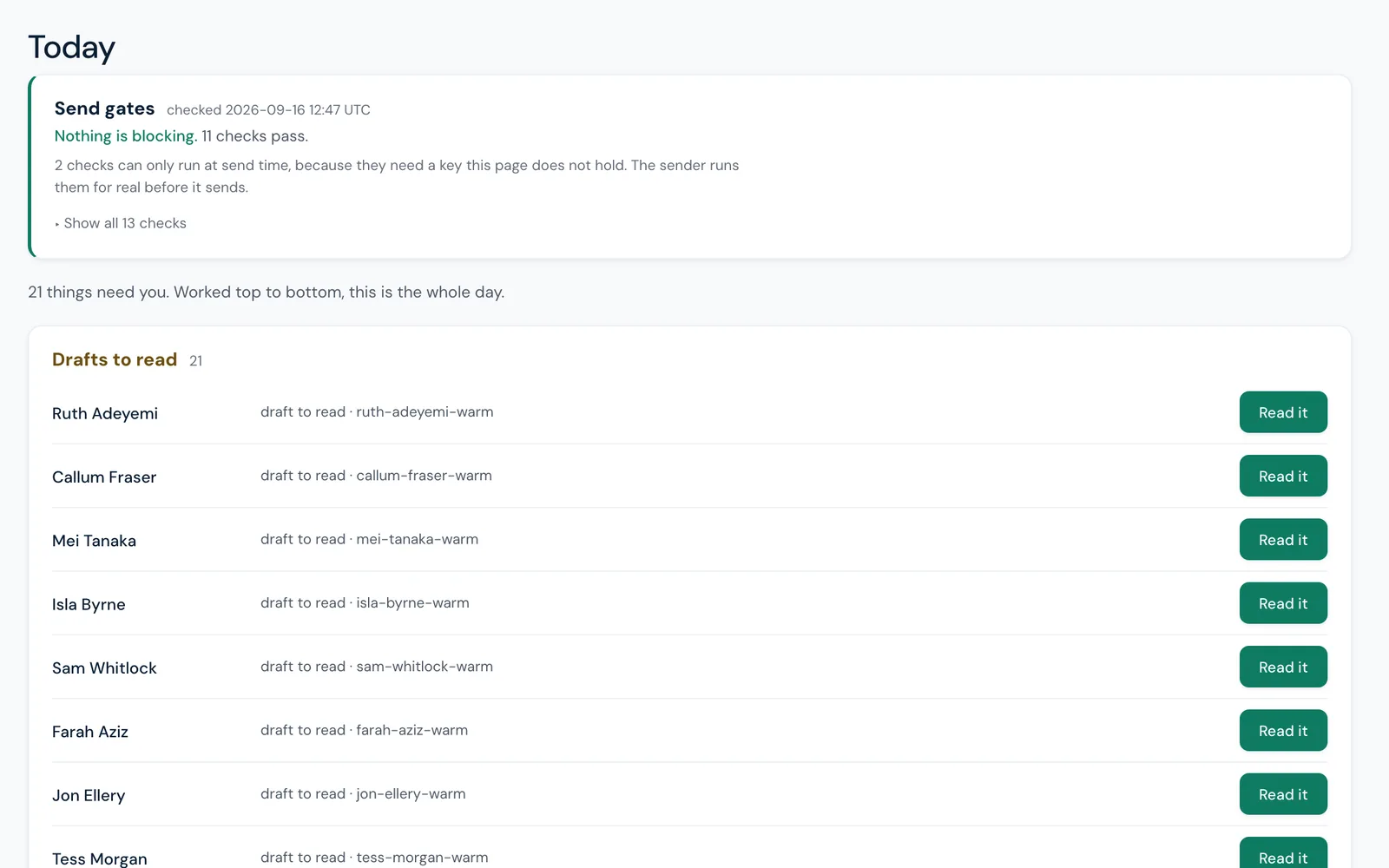
Then it drafts. A person reads every word. A draft only sends after somebody approves that exact text. Change one word and the approval is void.
It stops the moment somebody replies.
The Today screen. The send gates sit at the top. Every draft below waits for a person to read it. The names are made up.
A consumer site lives or dies on whether people can find it. Ours has tens of thousands of pages. Nobody can watch that many by hand.
Somebody arriving on their own is also a different journey from a corporate rollout. It needs its own measurement, not a share of the same dashboard.
What it does
RevOps is the admin panel for our consumer sites. Its job is to get the most out of search, and out of the site itself.
It reads search data, what people do on the site, and payments. It looks at families of pages, because there are far too many to watch one by one.
It shows me the pages that rank and never get clicked. It shows me what people search for that we have no page for. It shows me how much arrives from AI answer engines.
And a thing nobody has measured says so. Never measured and everybody dropped out are different facts. They must not look the same.
If you want to talk about any of it
I am always happy to be asked how a piece of this works, including the parts that are not finished.