AI
6 steps to becoming an AI first organisation
One process, the same in every department, so everybody knows where they are.
Everyone says they want to be an AI first organisation. I hear it most weeks.
Then nothing changes. Or everything changes at once, in different directions. One team buys a tool. Another team tries a different one. A third waits to be told. Nobody can say where the organisation actually is.
Saying “AI first” does nothing until it turns into actions.
Agree one process
This is a job for the leadership team. Agree one process for the whole organisation. The same steps, the same words and the same sheets, in every department.
Then three things get easier.
- Everyone speaks the same language. “We are at Trial on the invoice run” means the same in finance as it does in sales.
- You know where you are. Every department can say which task it is working on and which step it has reached.
- You can see who needs training. If a team is stuck on a step, that is the skill to teach.
The six steps
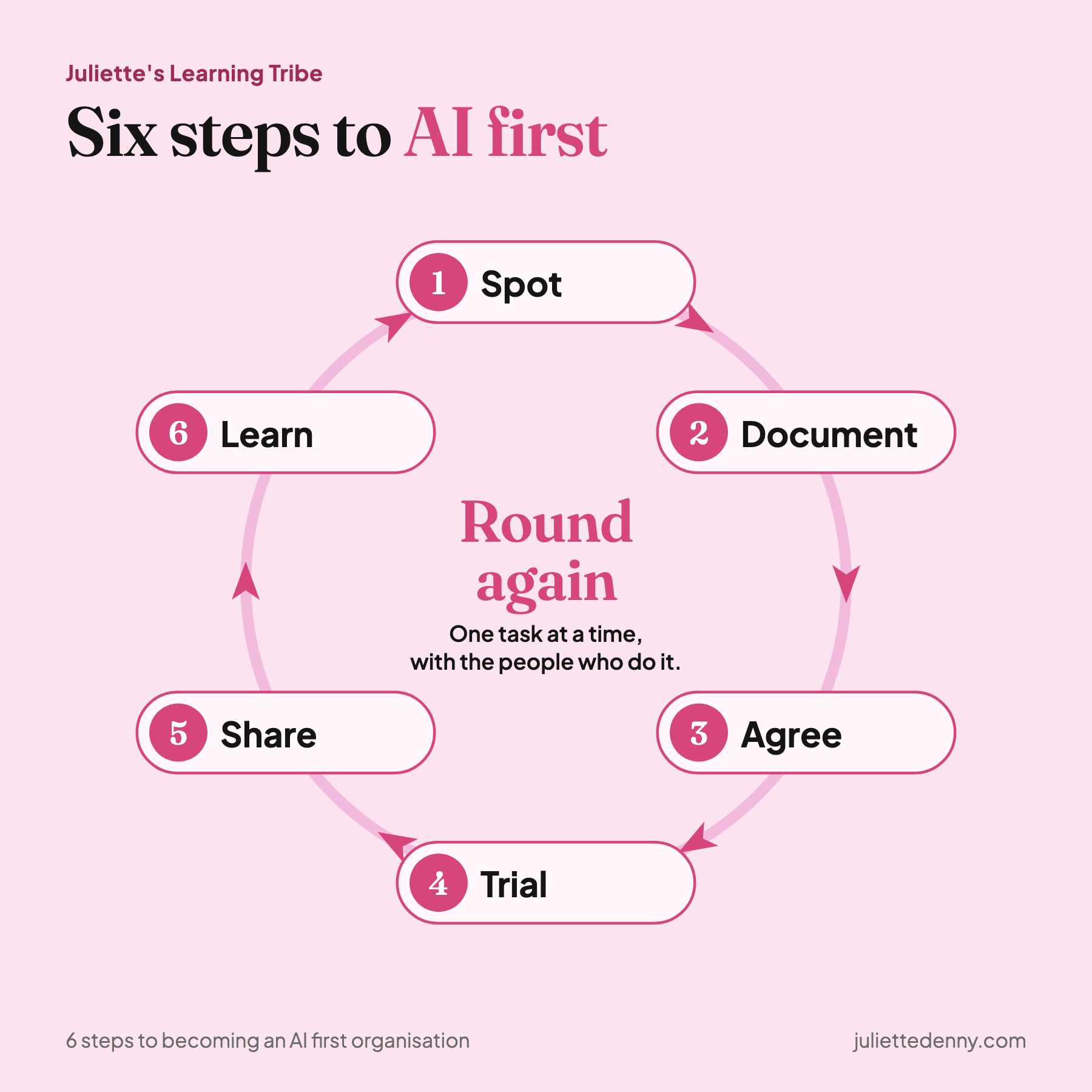
One task at a time.
1. Spot. Get the team in a room. List every task you repeat and how long it takes. Pick one that is dull, frequent and low risk. The people who do the work choose.
2. Document. Write down how that task is done today, step by step. Who does it, what good looks like, where it goes wrong. Time it on a real run.
3. Agree. Go through every step with the same people. Mark each one. AI does it. AI helps and a person checks. A person does it. Agree the rules: what can go into which tool, and who signs off.
4. Trial. Run the new way on real work for two weeks. Try to break it. Log everything it gets wrong.
5. Share. Show the team what happened, mistakes included. Then replace the write-up from step two with the new way.
6. Learn. Ask what changed for the people doing the job and what they need to learn next. Then go back to your list and spot the next task.
Teams stall at step two, because most work has never been written down. I found this with my own writing. I am dyslexic and I draft with Claude. The drafts did not sound like me until I wrote down how I write. That document is a standard operating procedure. Once it existed, AI could follow it.
Know where you are
Put every department on one page. Five columns: the department, the task, the step it has reached, what is in the way, and the training it needs. The workshop guide has this page ready to print.
Look at it once a month. If a department has sat on the same step for two months, ask them what training would move it.
Support everyone with training
Each step is a skill, and most of us were never taught it. At Zavmo we wrote Future Fluency to teach it, at two levels.
For the people who do the work: Future Fluency, Level 3. Use AI on real tasks and check what comes back. Automate something you repeat. Stay inside the rules. Turn your own data into a recommendation.
For the people who lead them: Future Fluency, Level 5. Use your department’s data to choose where to start. Plan automation across the department. Lead the people whose roles change. Finish with a year’s automation plan.
Either way, people learn by changing their own job.
To find out who needs which, ask each person to take the Future Fluency check. It is free and takes about 22 minutes. It tells them whether to start at Level 3 or Level 5. zavmo.ai/future-fluency-check
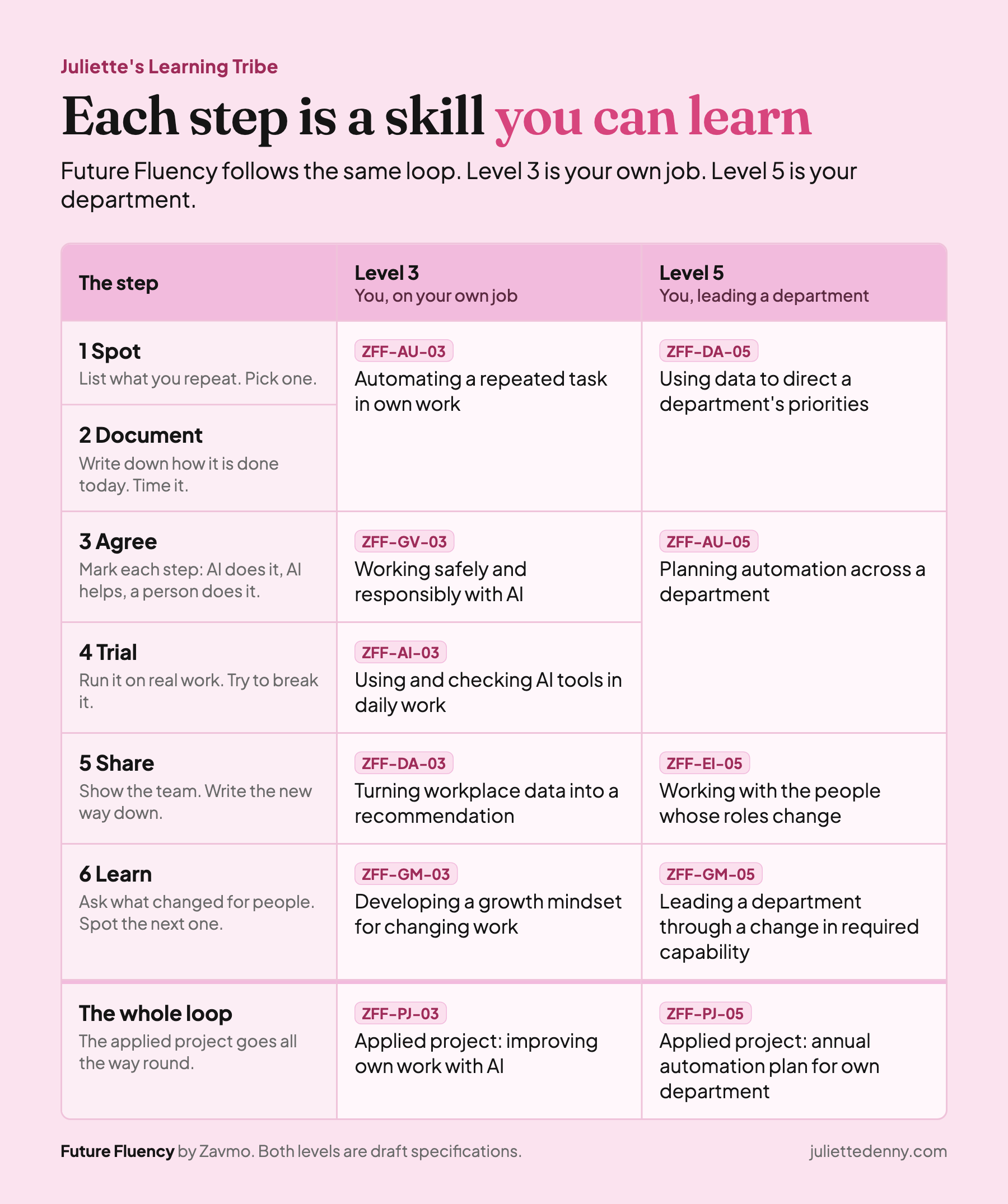
Both levels are written in full and both are still drafts. Tell me what is missing.
Start on Monday
- Put this process in front of your leadership team and agree it.
- Ask each department to pick one task.
- Run the first workshop. My free workshop guide has the run sheet and every sheet you need.
Download the free workshop guide
What would stop your organisation agreeing one process? Tell me on LinkedIn.
Juliette