AI
Who pays for the tokens?
10 steps a CTO takes before the people side of AI transformation.
This week I spoke to a CTO who had made a big decision. Claude Code, for everybody in the organisation. Not only the developers. I love it.
They wanted a people programme to go with it. Coaching and mentoring for every person. Each one learns how Claude makes their own job better.
That is exactly my work. So I started asking about the technology department.
How is your documentation kept? Are your coding standards written down? Where are you with ISO? Is your design system built from atomic parts? What does your CI/CD pipeline check? And what is the budget for tokens?
Each question set off three more.
The gap nobody plans for
When we talk about becoming AI first, we talk about people. Train everyone. Coach everyone. Get them using it.
We rarely ask if the organisation is set up for them to start.
Picture the Monday after the coaching. Someone in finance builds a workflow that checks invoices. It runs on tokens, every day.
Who approves the spend? Which data can it read? Where does the code live? Who checks it before it goes live? And who gets the bill?
In the organisations I talk to, there is rarely a process for any of that.
And here is the surprise. The better the coaching works, the worse this gets. Every person you coach comes back with something they want to build.
So the coaching works, the person gets excited, and then they hit a wall.
Or worse, they don’t hit one.
It is already the wild west
Your people are not waiting for IT. In 2024, Microsoft and LinkedIn surveyed 31,000 knowledge workers. 78% of AI users were bringing their own AI tools to work.
The company’s data goes with them. Netskope found the average organisation records 223 AI data policy violations a month. Source code is the biggest share, at 42%.
When it goes wrong, it costs. In IBM’s 2025 breach study, one in five organisations had a breach caused by shadow AI. Heavy shadow AI added $670,000 to the average cost of a breach. Only 37% had policies to manage it.
The code needs watching too. Google’s DORA research found that as AI use went up, delivery stability went down, by an estimated 7.2%. In Veracode’s tests of more than 100 models, AI-written code brought in a security flaw in 45% of tasks.
The developers know it. In Stack Overflow’s 2025 survey, 66% said their biggest frustration is AI answers that are “almost right, but not quite”.
The design drifts. In a small 2026 survey of 123 design system teams by zeroheight, 59% said screens were being built that bypass their design system.
And nobody is sure of the bill. CloudZero asked 500 US engineering leaders. They expected AI spend to rise 36% in a year. Only 51% could confidently judge the return.
Here in the UK, the government asked businesses that use or are considering AI. Only around a quarter have security practices to manage its risks.
AI makes you more of what you already are
Google’s 2025 DORA report put it in one line: “AI doesn’t fix a team; it amplifies what’s already there.”
That is the whole argument for doing IT first. Good standards get faster. Missing ones get louder.
And the fix works. When organisations give people approved tools, people use them. In a year, Netskope saw personal AI accounts fall from 78% to 47% of AI users. Company accounts rose to 62%.
So the answer is not to stop people. It is to build the road before the traffic arrives.
This is the CTO’s job, and it comes first.
The ten steps
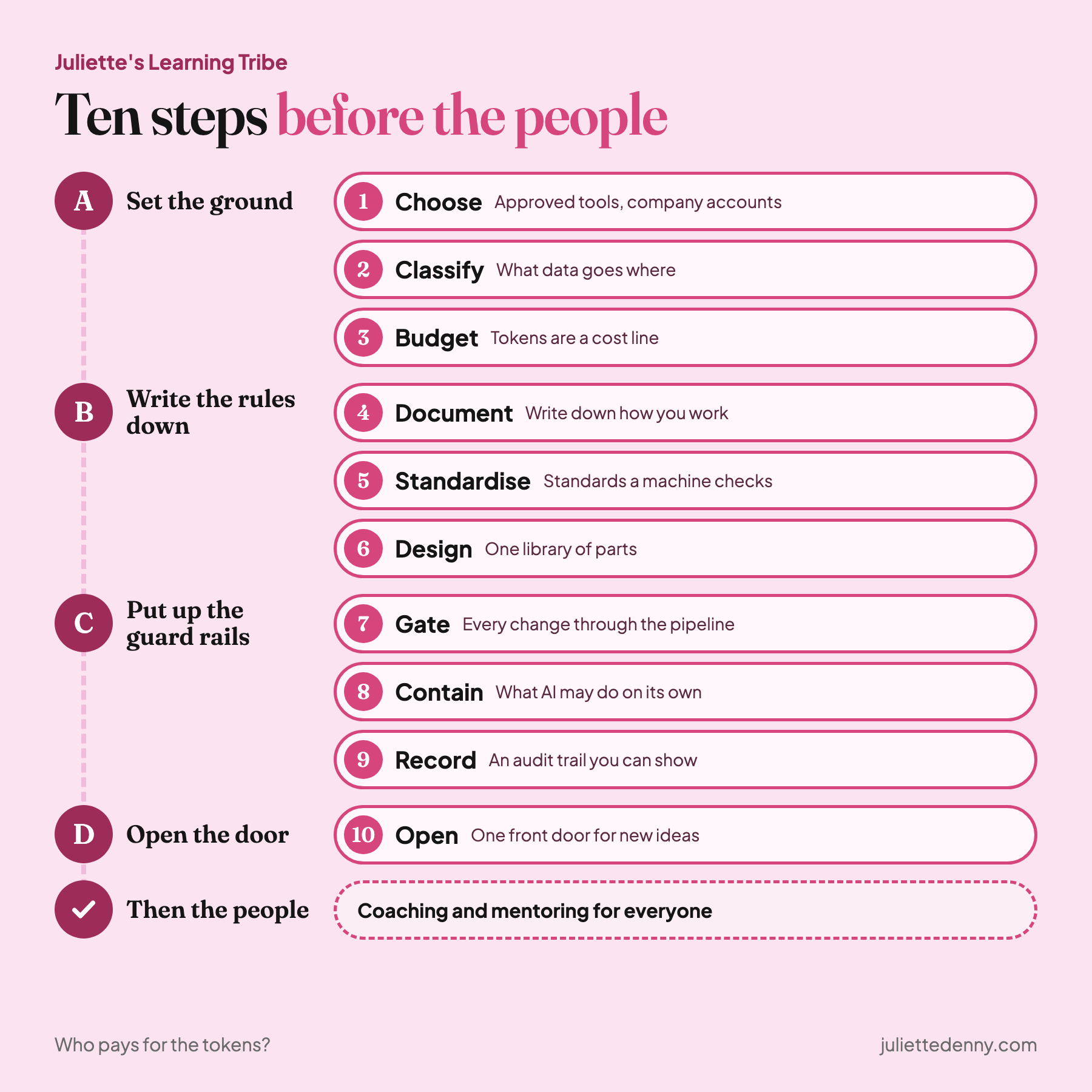
Four stages, in this order.
Set the ground
1. Choose. Pick the AI tools you back. Use company accounts with single sign-on. No company data in personal accounts.
2. Classify. Sort your data into three levels: open, internal and restricted. Write down which level can go into which tool.
3. Budget. Treat tokens as a cost line. Give each team a monthly limit, an alert before they reach it, and one way to ask for more. The better your people get, the bigger the bill. That is success, so plan for it.
Write the rules down
4. Document. AI follows what is written down. Every code base needs a short file that says how you work. What it connects to. What never to touch. AI is a new starter who arrives every morning and remembers nothing. That file is its induction.
5. Standardise. Write your coding standards down, then make a machine check them. A standard that lives in a senior developer’s head never reaches an AI.
6. Design. Build one design system from small parts, the atomic way. Then AI builds new screens from your parts instead of inventing its own.
Put up the guard rails
7. Gate. AI writes code faster than anyone can read it. So the pipeline reads it first. Every change goes through it. Tests, checks and a person’s review before anything goes live. Nobody, human or AI, pushes straight to live.
8. Contain. Decide what AI may do on its own, what needs a person’s approval, and what it never does. Keep production keys away from it. Give each agent its own workspace.
9. Record. Keep an audit trail you could show an auditor. Who asked, what changed, who approved it. If you hold ISO 27001, map AI to the controls you already have. ISO 42001 is the standard written for AI.
Open the door
10. Open. Give the business one front door for new AI ideas. One short form: the task, the data, the tool, the cost. One owner who says yes, no or not yet.
I learned step eight the hard way
Two of my AI agents once worked in the same folder at the same time. One sent the other’s files into our main code. Nobody reviewed them, because the change was meant to be about something else.
Two agents writing code side by side, on their own, still amazes me.
It was a small mistake and a big one. Small, because it was two files. Big, because nothing caught it.
Now every agent gets its own workspace. A guard stops any agent that tries to write into another one’s. It should have been there from the start.
Find out where you are
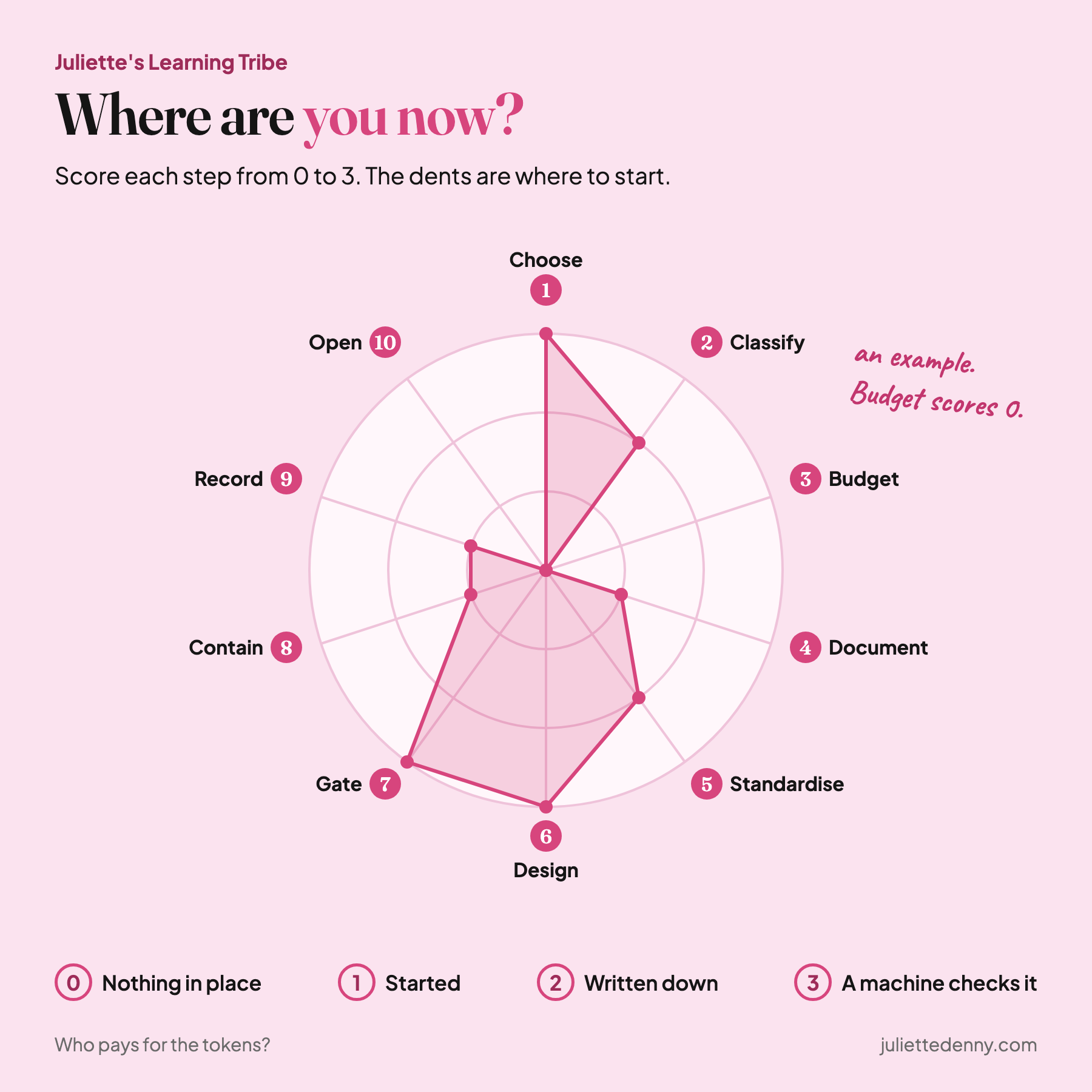
The workbook starts with a self-check. Score each step from 0 to 3.
0 means nothing is in place. 1 means you have started. 2 means it is written down. 3 means a machine checks it.
Plot your scores on the wheel and the gaps show up straight away.
The jump from 2 to 3 matters most. A rule that is written down is a rule a person can forget. A rule a machine checks is one AI cannot skip.
Then the people
Once the ten steps are in place, the coaching has somewhere to land. A person learns a new workflow on Tuesday. On Wednesday they know exactly how to get it approved.
That is where last issue’s workshop guide comes in. Six steps, one task at a time, with the people who do the work.
Last issue: 6 steps to becoming an AI first organisation
Start on Monday
- Take the self-check with your heads of engineering, security, data and finance.
- Pick your lowest score and give it an owner, by name.
- Answer one question in writing. Who pays for the tokens?
My free workbook has a sheet for every step.
What would your CTO say if you asked who pays for the tokens? Tell me on LinkedIn.
Juliette
Sources
- Microsoft and LinkedIn, 2024 Work Trend Index, May 2024
- Netskope Threat Labs, Cloud and Threat Report 2026, January 2026
- IBM, Cost of a Data Breach Report 2025, July 2025
- Google Cloud, 2024 DORA Accelerate State of DevOps report, October 2024
- Google Cloud, 2025 DORA State of AI-assisted Software Development, September 2025
- Veracode, 2025 GenAI Code Security Report, July 2025
- Stack Overflow, 2025 Developer Survey, AI section
- zeroheight, State of AI in Design Systems, 2026
- CloudZero, State of AI Costs 2025
- UK Government, Cyber Security Breaches Survey 2025/2026, April 2026