AI
What did the board decide?
So your board decided your company is now AI first. What does that mean?
Two weeks ago I wrote about the people side of AI. Six steps, one task at a time, with the people who do the work.
Last week I wrote about the IT side. Ten steps a CTO takes before the coaching starts.
Both kept running into the same wall. The board.
What my board conversations are about
Most of my board-level conversations start the same way. The board says, “We want the company to be AI first.”
Then I ask what that means. What impact are you looking for? In what order? What comes first?
Most boards cannot say yet.
So the people who have to make it happen have no priorities to work to. Every team picks its own direction. And impact is almost impossible to manage, because nobody set a goal.
A board cannot set the goal until it is clear on the impact it wants. So the board has to direct the specifics. Not leave them to each team.
Where is the low hanging fruit? Which processes should AI make faster first? In what order?
And the board has to put the people change in place before anything moves. Otherwise the organisation freaks out.
If the board does not direct the specifics, it ends up like the wild west. Every team buys its own tools, chases its own wins and measures in its own way. Last week I showed what that looks like in IT. This is where it starts.
Boards are talking. Few have decided.
The research says the same thing.
NACD asked 146 US public company directors what their boards had actually done about AI in 2025. 62% had set aside board time to discuss it. Only 23% had rethought strategy. 9% had approved a budget. 6% had set measures.
Deloitte surveyed 695 board members and executives in 56 countries in 2025. Only 5% said AI was built into their business and operating plans.
It is not mainly about knowledge. The UK’s Chartered Governance Institute ran roundtables with governance professionals in 2026. Its finding: “Confidence, not knowledge, is the primary constraint.” AI adoption is “largely bottom-up” and “board visibility is often limited”.
Leaders feel it too. In Microsoft and LinkedIn’s 2024 study, 60% of leaders worried their leadership lacked a plan and vision for AI.
Without direction, it goes underground
People do not wait. KPMG and the University of Melbourne asked more than 48,000 people in 47 countries. 57% said they hide their use of AI at work.
Most are not told the plan. In 2026, Gallup found only 25% of US employees say their organisation has communicated a clear plan for AI. Where people strongly agree there is one, they are three times as likely to feel very prepared to work with it.
Here in Great Britain, Acas found job losses are the single biggest AI worry at work, named by 26% of employees.
That is the wild west, and it starts with silence at the top.
Direction and value go together
Protiviti surveyed 772 board members and executives at the end of 2025. Among organisations getting a high return from AI, 63% discuss it at every board meeting. Among those getting a low return, 13% do.
That does not prove cause. It does point one way.
A mood, not a decision
“We will be AI first” is not a decision. It is a mood.
A mood travels badly. Sales hears “move fast”. IT hears “lock it down”. Finance hears “cost”. HR hears nothing at all.
So people fill the silence themselves. And people fill silence with fear.
That is the part that surprised me. The first thing your people learn about AI is not what the board says. It is what the board does not say.
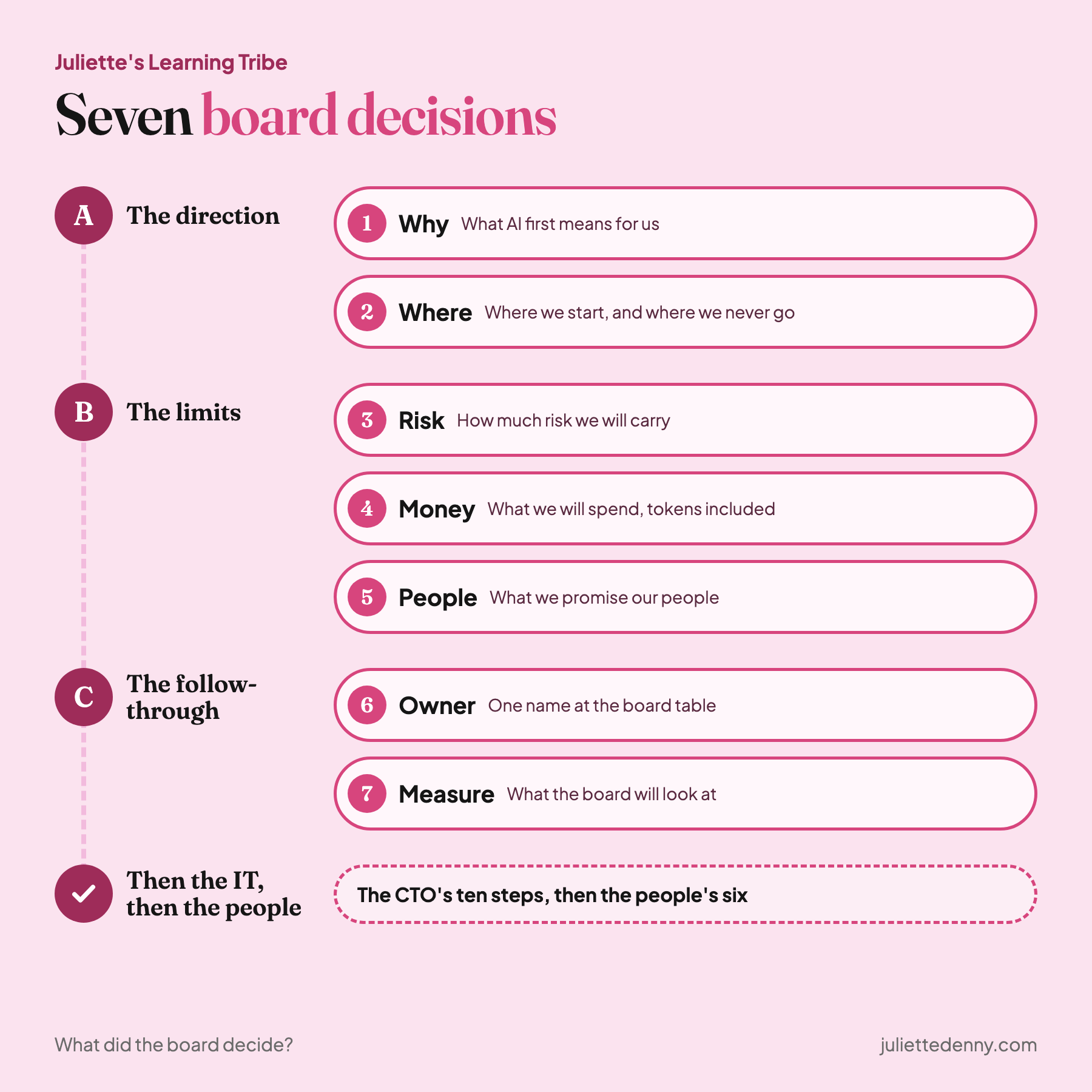
The seven decisions
Three groups. Direction first, then limits, then follow-through.
The direction
1. Why. What AI first means for us, in one sentence. Not a slide. A sentence the newest starter can repeat.
2. Where. Where we start, and where we never go. Start with work that is dull, repeated and low risk. Name the places AI does not touch.
The limits
3. Risk. How much risk we will carry. What AI may decide on its own, what it may only suggest, and what it never touches. Write it down before something goes wrong, not after.
4. Money. What we will spend, tokens included. Tokens are a running cost, not a one-off. The board does not need to understand them. It needs to decide who pays.
5. People. What we promise our people. Will roles change? Will we train before we change them? Say it before the rumour does.
The follow-through
6. Owner. One name at the board table. Not a committee. One person who can say yes, no or stop.
7. Measure. What the board will look at, and how often. Decide when you will scale. Decide when you will stop, too. A pilot with no end date is not a pilot.
Minutes are not a decision
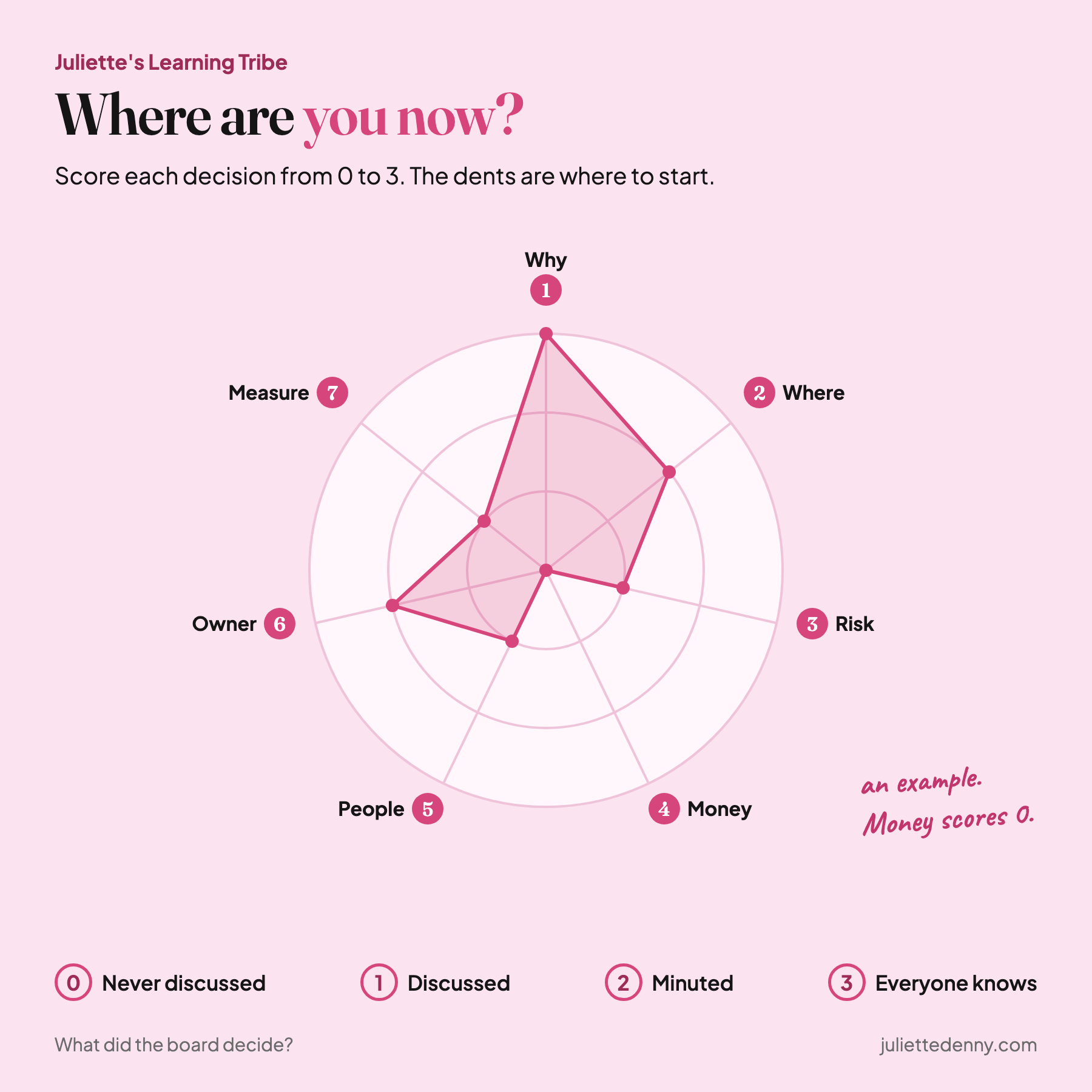
The workbook starts with a self-check. Score each decision from 0 to 3.
0 means we have never talked about it. 1 means we have talked about it. 2 means it is decided and minuted. 3 means the whole company knows.
The jump from 2 to 3 is where most of the work is. A decision that only lives in the minutes has not been made yet. It is made when the newest starter can say it back to you.
One page on the wall
The workbook ends with one page. Seven sentences, one per decision, signed by the chair and the CEO.
That page is what the whole company reads. It is what the CTO builds the guard rails from. It is what the coaching starts from.
Then the IT, then the people
This is the first of three, even though I wrote it last.
The board decides. The CTO sets up the ground. Then the people learn, one task at a time.
Last issue: Who pays for the tokens?
The issue before: 6 steps to becoming an AI first organisation
Start on Monday
- Put the self-check on your next board agenda.
- Name one board owner for AI, by name.
- Write the first sentence. What does AI first mean for us?
My free workbook has a page for every decision, and a two-hour board session to run it in.
Could your board say what AI first means for you, in one sentence? Tell me on LinkedIn.
Juliette
Sources
- NACD, 2025 Public Company Board Practices and Oversight Survey, AI oversight activities, July 2025
- Deloitte Global Boardroom Program, Governance of AI: A critical imperative for today’s boards, 2nd edition, 2025
- Chartered Governance Institute UK & Ireland, Equipping Governance Professionals to Lead AI Conversations, July 2026
- Microsoft and LinkedIn, 2024 Work Trend Index, May 2024
- KPMG and the University of Melbourne, Trust, attitudes and use of AI: A global study 2025, May 2025
- Gallup, AI indicator, 2026
- Gallup, AI Use at Work Has Nearly Doubled in Two Years, June 2025
- Acas, 1 in 4 workers worry that AI will lead to job losses, April 2025
- Protiviti and BoardProspects, Global Board Governance Survey, March 2026